Taxpayers Deserve the Cohere Term Sheet Before Ottawa Bets $1.6 Billion
Ottawa says the Cohere investment is commercial and staged. Good. Then publish the commercial terms taxpayers are buying.
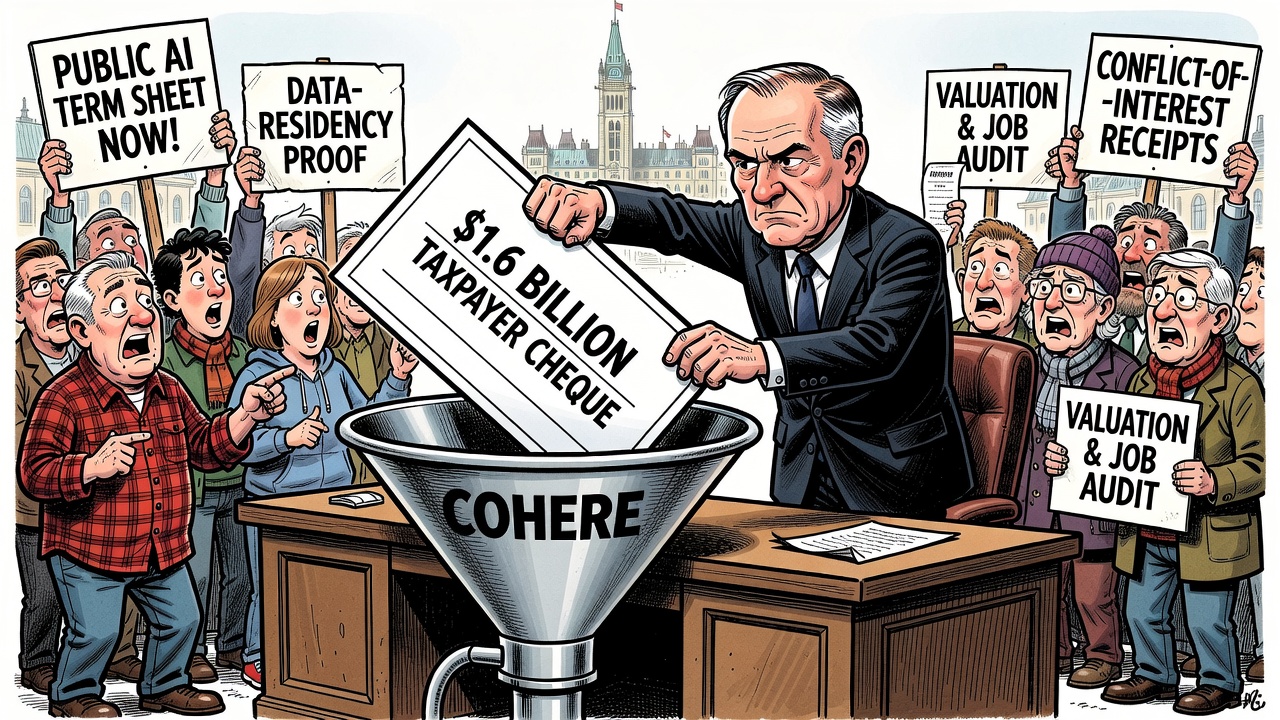
When a government writes a cheque for ordinary grants, taxpayers deserve receipts. When it proposes to become an equity investor in one private AI company for up to $1.6 billion, taxpayers deserve the term sheet.
Prime Minister Mark Carney announced on October 29 that Canada plans to make a staged, commercial equity investment of up to approximately $1.6 billion in Toronto-founded Cohere. The Prime Minister’s Office says the round includes private investors such as NVIDIA, Bell and Schwarz Group, and that Cohere will create at least 1,000 new Canadian technical jobs by 2030, invest at least $1.7 billion in additional Canadian computing infrastructure by 2030, and maintain Canadian incorporation and headquarters.
Those are serious commitments. They are also not the same thing as public accountability. Canadians still do not know the valuation Ottawa accepted, the share class taxpayers receive, the downside protections, the liquidation preferences, the milestone gates, the clawback rules, the board or observer rights, or how the promised jobs and infrastructure spending will be audited. A press release can describe ambition. It cannot substitute for investment discipline.
The government’s own framing raises the stakes. Carney’s speech said Canada has secured “strong terms,” that Canadians will own a stake in Cohere, and that the federal public service is already working with the company. If departments are using Cohere while cabinet is taking a major equity position, Ottawa must show the procurement firewall too: existing contracts, pilot projects, data-residency rules, privacy assessments, lobbying contacts, conflict screens and future sole-source restrictions.
None of this is an argument against Canadian AI companies. Conservatives should want Canada to build strategic technology capacity at home instead of surrendering every critical platform to foreign giants. But industrial policy without hard public terms becomes political venture capital: public money up front, political ribbon-cutting now, and taxpayers left to discover years later whether the promised upside was real.
The sober test is simple. If this is a commercial investment, publish the commercial protections. If the investment is staged, publish each stage gate. If the jobs are guaranteed, publish the audit method. If data sovereignty is the selling point, publish the data-location and access rules. If government departments are customers, publish the procurement record and prove Cohere will not receive inside-track treatment because taxpayers became shareholders.
Canada does not need another opaque Ottawa bet sold as transformation. It needs a public ledger that separates genuine national capacity from subsidy theatre. Before another dollar is drawn down, Parliament should see the valuation, rights, risks and conflict safeguards behind the Cohere deal. Taxpayers are being asked to act like investors. They should be treated like investors.
- Prime Minister of Canada: Canada announces landmark investment in Cohere to scale secure, sovereign AI
- Prime Minister of Canada: Prime Minister Carney speech on Cohere investment
- Reuters via MarketScreener: Ottawa takes stake in Cohere as AI company opens funding round
- Associated Press: Canada plans investment in AI startup Cohere
This article argues for public investment-accountability safeguards. It does not allege wrongdoing by Cohere or any named investor.