Carney’s Alberta Immigration Deal Talk Needs Receipts
Ottawa says immigration is back under control. Alberta voters just demanded more control. The next step should be a public ledger, not another closed-door bargain.
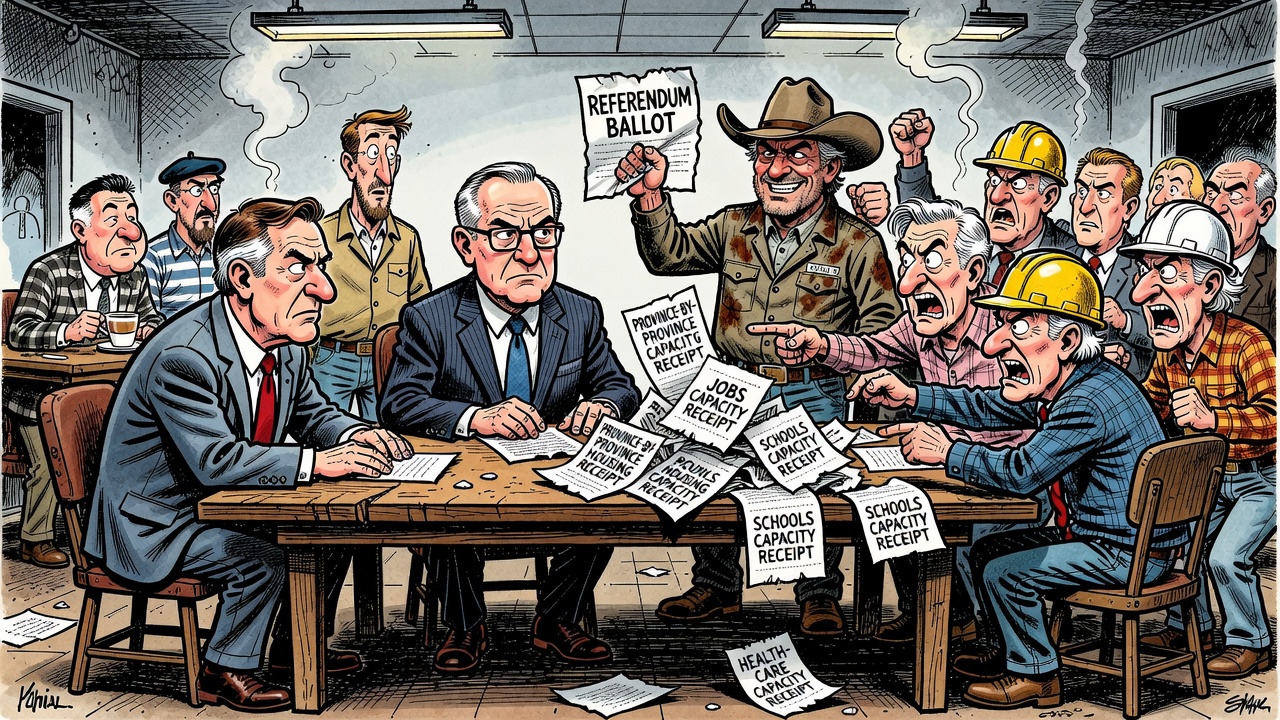
Prime Minister Mark Carney has been telling Canadians that Ottawa has “retaken control” of immigration. Alberta has now answered with a practical question: control by whose measure, and backed by what receipts?
Global News, citing The Canadian Press, reported that Carney would not rule out a Quebec-style immigration agreement for Alberta. Asked whether such a deal was possible, he replied in French, “We’ll see.” The same report said he insisted Ottawa would not budge from what he calls sustainable immigration levels while still talking with provinces. That is the tension: a federal government claiming control while provinces ask for proof that federal targets match housing, jobs, schools and health-care capacity.
Alberta Premier Danielle Smith says her government is preparing a proposal and looking to Quebec’s 1991 immigration accord for inspiration. CityNews reported Elections Alberta’s unofficial count was complete on October 24 and that immigration-related referendum questions had majority “yes” results, with official results still to be posted by Elections Alberta. In other words, this is no longer just another Ottawa talking point. It is now a federal-provincial negotiation question with voters attached.
Carney’s government will point to Immigration, Refugees and Citizenship Canada’s 2026–2028 levels materials, which say Ottawa is reducing new temporary-resident arrival targets, stabilizing permanent-resident admissions and aiming to bring the temporary-resident population below five per cent of Canada’s population by the end of 2027. Fine. Then publish the math province by province.
A conservative accountability standard is simple: no special deal, no national target and no ministerial victory lap without a capacity ledger. Canadians should see annual admissions, temporary-resident counts, expected exits, asylum backlog impacts, housing completions, rental vacancy pressure, health staffing, school enrolment pressure, labour-market demand and the fiscal cost shifted to provincial and municipal services. If Ottawa says the plan is sustainable, it should be able to show sustainability in Alberta, Ontario, British Columbia, Quebec and every other province — not just in a national press release.
There is also a fairness problem. If Quebec has one immigration arrangement and Alberta is now asking for another, Ottawa must explain what principle governs the map. Is the rule population pressure? Labour shortages? Language? Constitutional negotiation? Political pressure? Canadians deserve a transparent standard before the federal government starts handing out bespoke immigration powers one province at a time.
Carney may be right to talk with Alberta. He is wrong if the conversation happens before the numbers are public. “Retaken control” is a slogan. Province-by-province receipts are control.
- Global News / The Canadian Press: Carney will not rule out Quebec-style immigration agreement with Alberta
- IRCC: Supplementary information for the 2026–2028 Immigration Levels Plan
- IRCC: Immigration Levels Plan
- CityNews Edmonton: Record unofficial count of ballots complete after referendum
- Elections Alberta: Referendum results
- Associated Press: Carney celebrates Alberta vote against independence
This article focuses on federal-provincial accountability and capacity disclosure, not on reducing individual immigrants to statistics.