Carney’s 380,000 Immigration Number Needs an All-In PR Ledger
The headline number is not the whole accountability number. Canadians deserve one public ledger showing every permanent-residence stream, every temporary-resident target, and every capacity test behind the plan.
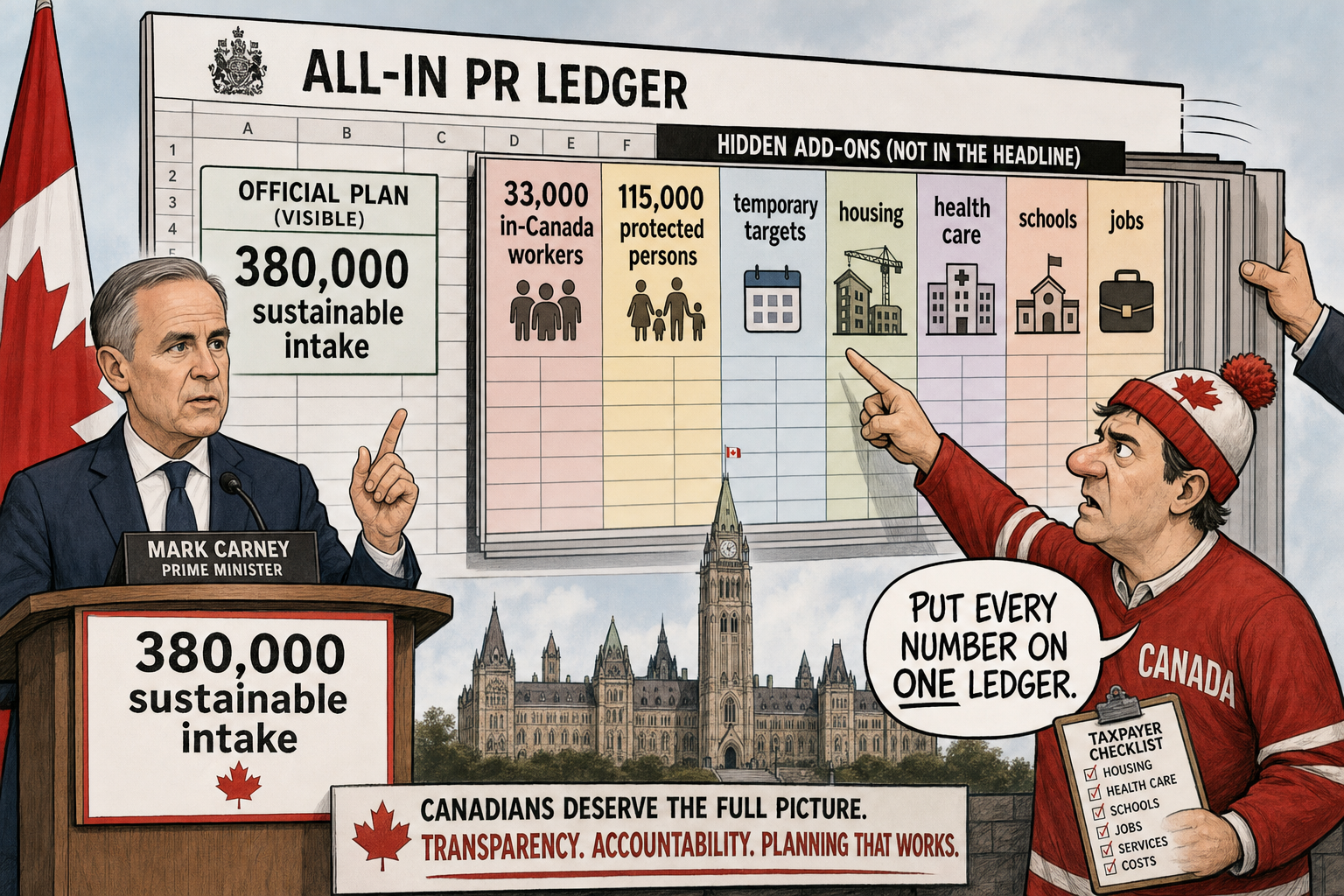
Carney’s government wants Canadians to hear one number: 380,000. IRCC says the 2026 Immigration Levels Plan targets 380,000 new permanent residents, and its public dashboard says 216,600 people received permanent resident status from January through August 2026. That may be the official baseline. It is not the full receipt.
The same IRCC page states that two 2026–2027 one-time initiatives are “in addition to, not part of” the levels-plan targets. Those words matter. One initiative accelerates permanent residence for 33,000 in-Canada workers over two years, including at least 20,000 in 2026. Another processes applications from up to 115,000 protected persons and in-Canada dependants over two years, with 46,000 planned for 2026.
No serious government should pretend Canadians are confused for asking how those numbers fit together. If Ottawa says the system is returning to “sustainable levels,” then the public should see the all-in permanent-residence intake number beside the advertised target. A family waiting for a doctor, a classroom already using portables, a renter competing in a tight market and a young worker looking for entry-level work all live with the total pressure, not the communications category.
The supplementary levels plan adds another layer. Ottawa says permanent resident admissions will stabilize at 380,000 from 2026 to 2028, while temporary-resident arrival targets are 385,000 in 2026 and 370,000 in 2027 and 2028. It also promises to reduce the temporary population below 5 percent of Canada’s total population by the end of 2027. That is an ambitious balancing act. It deserves measurement in public, not trust-us language.
There is a political fight here, too, but it should be handled carefully. Conservatives have alleged that corporate lobbying is shaping the numbers, and independent reporting says Liberal MPs adjourned two immigration-committee debates on October 22, including one tied to reducing levels before the next plan. Allegations are not proof. But shutting down debate is a terrible look when the official math already requires explanation.
The accountability standard is straightforward: publish one immigration ledger before the next plan. It should show baseline PR targets, one-time PR initiatives, actual admissions to date, temporary arrivals, asylum and permit assumptions, province-by-province housing capacity, health-care pressure, school-capacity data, job-market impacts, wage evidence, exit tracking and the departments responsible for each number.
Immigration can serve Canada when it is honest, paced and matched to capacity. It loses public trust when Ottawa markets one figure while consequential add-ons sit elsewhere on the page. If 380,000 is sustainable, Carney should prove it with the all-in ledger.
- IRCC: Understanding permanent residence numbers in Canada
- IRCC: Supplementary Information for the 2026–2028 Immigration Levels Plan
- CPAC: Conservative MPs hold a news conference on Parliament Hill
- Todayville Calgary: Liberals gag immigration debate after Conservatives accuse Carney of letting corporate lobbyists set the numbers
This article uses IRCC’s official levels-plan pages for the intake figures and treats the corporate-lobbying claim as an opposition allegation, not a proven fact.