Carney’s Heat-Pump Rebate Needs a Conflict Ledger
A $2 billion retrofit program can be argued on affordability grounds. But when the Prime Minister already has a Brookfield conflict screen, taxpayers deserve the vendor, recusal and audit receipts before the money flows.
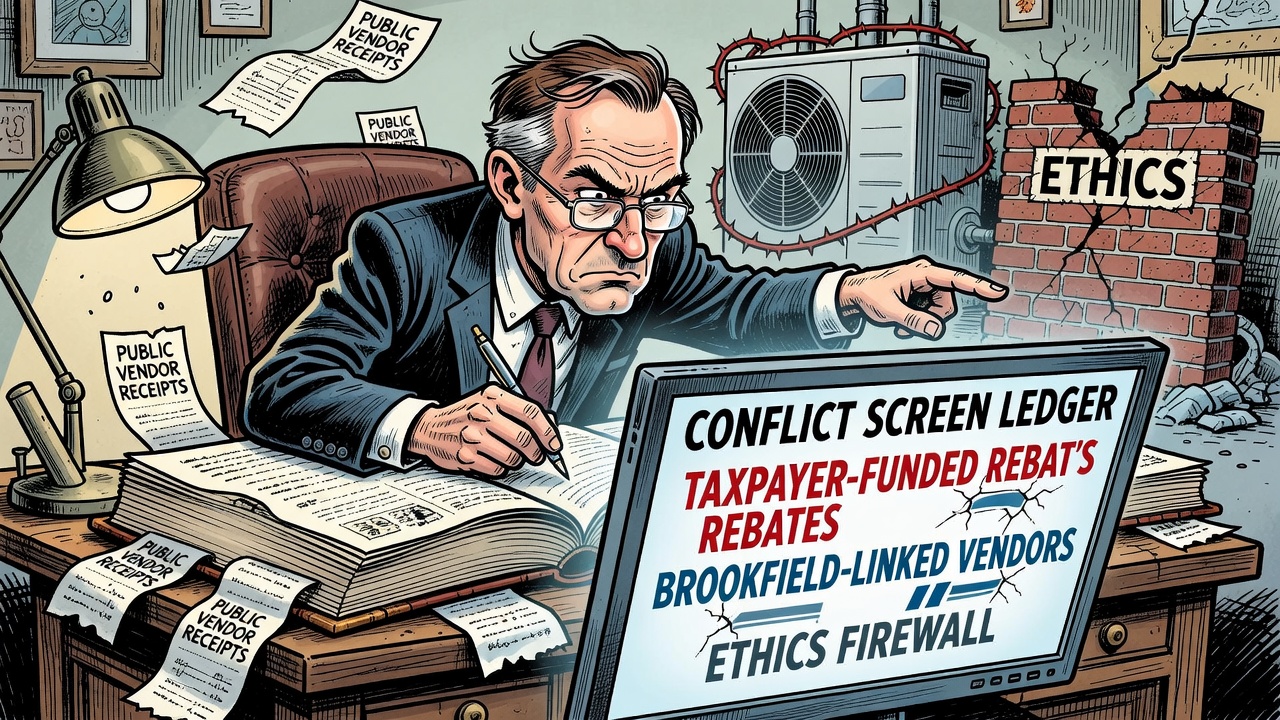
Prime Minister Mark Carney’s October 8 announcement put big numbers behind a familiar Liberal promise: $2 billion to help deliver one million home retrofits, including a National Heat Pump Rebate for up to 820,000 households. The government says below-median-income households can receive up to $10,000, other eligible households can receive $2,000, and families switching from oil or electric baseboards could save an average of $1,400 a year.
That may sound like practical affordability policy. In many homes, replacing a broken heating system is not optional. But the accountability problem is also obvious: Ottawa is about to subsidize a market where equipment suppliers, installers, lenders and service firms may all benefit. When the Prime Minister’s own ethics file includes a Brookfield conflict screen, “trust us” is not enough.
Conservative MP John Brassard raised the issue in the House the same day, alleging that Trane and Enercare are Brookfield-linked participants in the heat-pump market and asking how much Carney or Brookfield could benefit from the rebate push. Allegations in Question Period are not proof of misconduct. They are, however, a warning light. The correct response is not partisan hand-waving; it is disclosure.
The Ethics Commissioner’s public registry says Carney agreed to a conflict screen aimed at preventing opportunities to further his own interests or improperly further those of Brookfield Asset Management, Brookfield Corporation, Stripe Inc., and companies owned or controlled by them that he knew of when his blind trust was established. It also says the screen is administered by his chief of staff and the Clerk of the Privy Council, and that matters caught by the screen are to be handled by the appropriate minister.
So publish the receipts. Canadians should see the eligible-vendor list, any Brookfield-linked entity review, the departmental conflict analysis, the recusal record, the minister assigned to screened matters, the rebate-flow safeguards, the audit plan and clawback rules. If no Brookfield-linked company can receive a direct or indirect benefit, say so plainly and show the rule. If broad market programs are exempt because they apply generally, explain that legal reasoning before billions are committed.
This is not an argument against every heat pump, every retrofit, or every household trying to cut winter bills. It is an argument against using affordability language to blur conflict risk. A government serious about clean energy and ethics should welcome a public ledger, because clean programs need clean governance.
Carney’s Liberals want credit for moving fast. Fine. But speed is not a substitute for safeguards. Before taxpayers subsidize the next furnace replacement, the government should prove the program is helping households — not quietly underwriting connected players in a market the Prime Minister’s own screen already tells Canadians to watch.
- Prime Minister of Canada: Prime Minister Carney announces landmark investment to retrofit one million homes
- OpenParliament: John Brassard on Finance, October 8, 2026
- Office of the Conflict of Interest and Ethics Commissioner: Mark Carney public declaration of agreed compliance measures
- Western Standard: Carney faces conflict of interest allegations over $2 billion heat pump rebate program
This article argues for conflict-of-interest transparency and taxpayer safeguards. It does not allege that any law has been broken or that every retrofit subsidy is improper.