Carney’s EV Rebates Need a Free-Rider Ledger
If Ottawa calls EV rebates an affordability program, it should prove the money is reaching families who need the help — not subsidizing purchases that would have happened anyway.
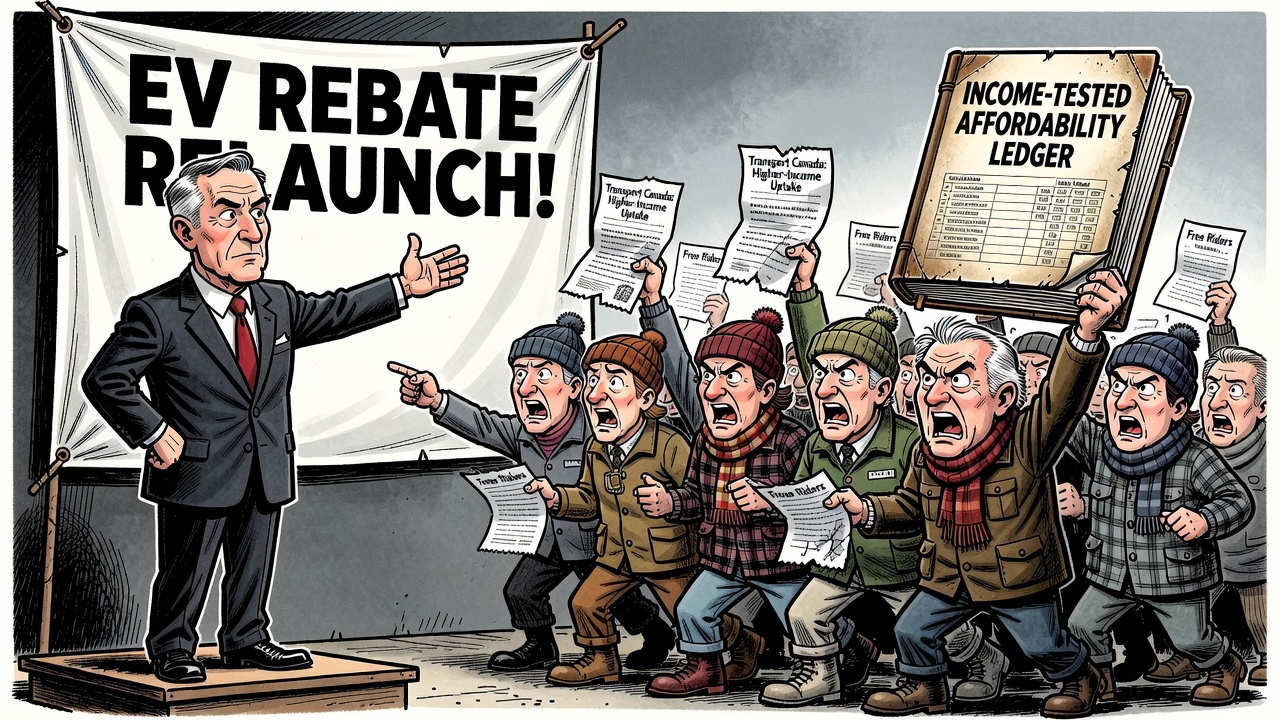
The Carney government’s Electric Vehicle Affordability Program is being sold as consumer relief and climate policy at the same time. Global News reported in February that the plan carried $2.3 billion in funding, with rebates of up to $5,000 for battery-electric and fuel-cell vehicles and up to $2,500 for plug-in hybrids. Canada’s current EV incentive page says eligible light-duty vehicles can still receive up to $5,000 at the point of sale in 2026, with eligibility tied to transaction value and country-of-origin rules.
That sounds tidy until Canadians read Transport Canada’s own evaluation of the previous rebate programs. The department found that the old iZEV program increased zero-emission vehicle uptake. But it also flagged the exact accountability problem Ottawa should have fixed before launching a new version: free riders and higher-income concentration.
In Transport Canada’s 2024 recipient survey, 22.9 percent of individual respondents and 22.5 percent of organization respondents said they would have bought a zero-emission vehicle even without the incentive. In plain English, nearly one-quarter of surveyed recipients were potentially getting taxpayer help for a purchase they already planned to make. That may be a nice bonus for the buyer. It is not automatically a good deal for the taxpayer.
The income data are just as important. Transport Canada reported that the majority of individual survey respondents had household income above $100,000, while only 5 percent reported household income below $50,000. The evaluation also said future incentives should consider more targeted approaches, including income testing. That is not a conservative talking point. That is the government’s own program evaluator describing who received the benefit and how the design could be tightened.
A serious affordability program should pass an affordability test. If the rebate mostly helps higher-income households buy vehicles they could already afford, Ottawa should stop calling it relief for working families. If the government believes the new design fixes the problem, publish the proof: recipient income bands, final vehicle prices, model eligibility, geography, Canadian-made exemptions, dealer reimbursement delays, estimated free-rider rates and emissions reductions per public dollar.
There is a defensible case for lowering emissions. There is also a defensible case for helping middle- and lower-income households access cleaner transportation. But there is no defensible case for hiding distributional results while borrowing billions and branding the spending as affordability.
Carney does not need another green-subsidy slogan. He needs a public EV rebate ledger. Before the next round of cheques goes out, Canadians should see who benefits, what changed from the last program, and whether the rebate is buying new behaviour or merely rewarding decisions already made.
- Transport Canada: Evaluation of the Incentives for Zero-Emission Vehicles Program and Incentives for Medium- and Heavy-Duty Zero-Emission Vehicles Program
- Government of Canada: Electric vehicle incentives
- Global News: Canada announces new auto strategy as tariff threats loom
This article argues for tighter public accountability on rebate design. It does not argue against all zero-emission vehicle adoption or cleaner transportation policy.