Carney Denies U.S. Election-Interference Claims. Publish the Midterm Firewall.
A denial may be accurate. It is not the same thing as a public firewall.
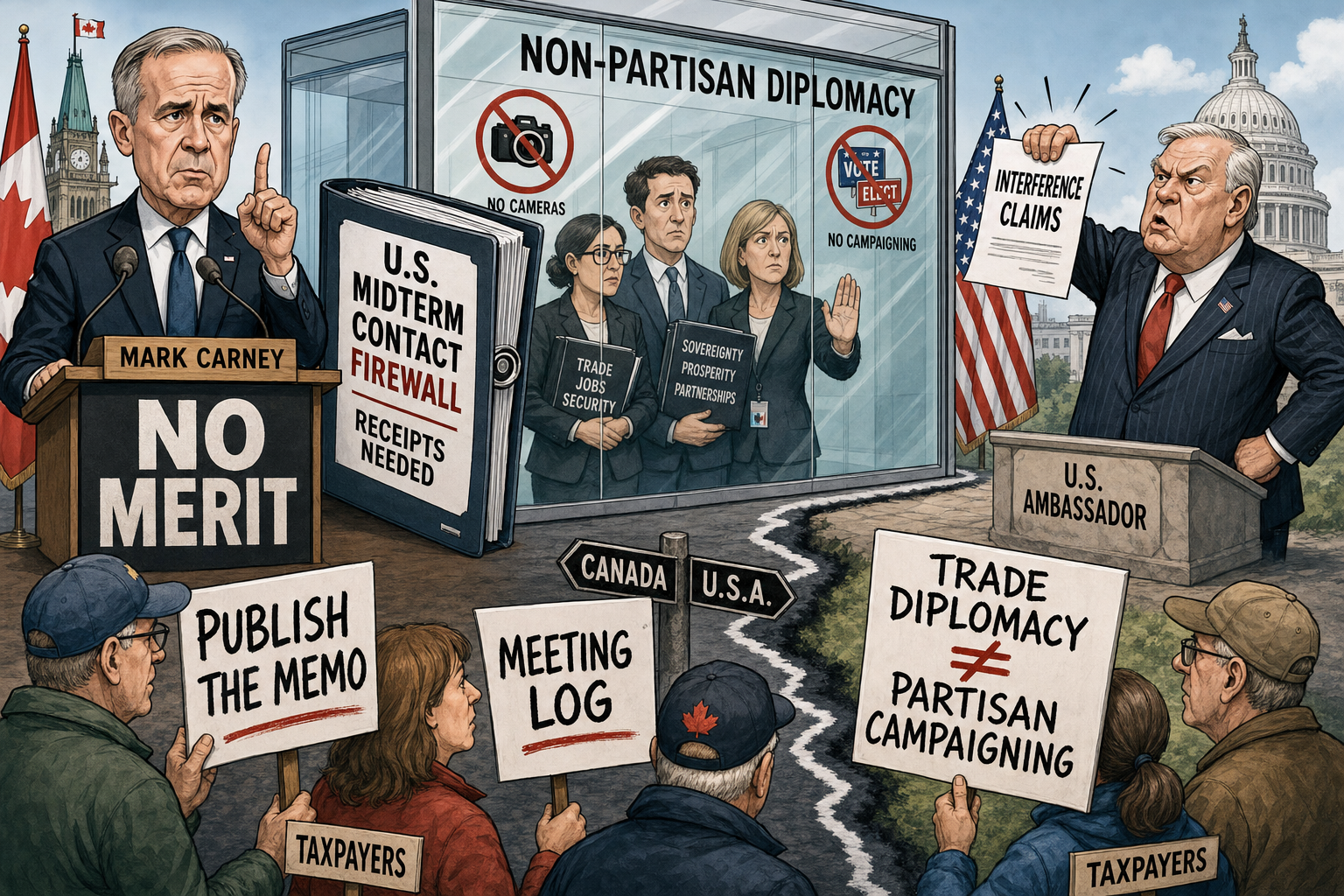
Prime Minister Mark Carney may be right that Washington’s latest allegation is political theatre. The United States Embassy has accused Canadian politicians of trying to influence U.S. midterm politics, and Carney answered on October 23 that the claim has “no merit.” That denial matters. Canada should not quietly accept a sloppy accusation from any foreign government.
But a conservative accountability standard does not end with Ottawa saying “trust us.” If Liberal ministers, MPs, diplomats and provincial politicians are operating in the middle of a U.S. election season, Canadians deserve clear rules separating legitimate trade advocacy from partisan election activity.
The public record already shows why a firewall is needed. The Associated Press reported that the U.S. Embassy fact sheet pointed to Canadian political comments and appearances, including Mélanie Joly’s earlier discussion of retaliatory tariffs aimed at Republican states and Ontario Premier Doug Ford’s anti-tariff advertising campaign in the United States. Axios reported that the embassy also cited Joly meetings with Democrats, Liberal MP Anthony Housefather campaigning for a U.S. Democrat, and Canadian anti-tariff messaging in politically important states.
Those examples are not proof of an official Canadian interference campaign. Some may be ordinary politics, provincial advocacy or private partisan activity. Some may be overblown by an American administration using tariffs and election rhetoric as leverage. That is exactly why Ottawa should publish receipts rather than ask Canadians to choose between two press-release versions of reality.
Canadian Press, via iPolitics, reported that Global Affairs Canada circulated a memo telling diplomats not to meet with, or attend events involving, U.S. midterm candidates during this heightened period. Good. Now publish the non-sensitive version of that memo. Canadians should know when the rule started, who it covers, whether ministers and parliamentary secretaries are included, how campaign events are defined, what exceptions exist for official business, and who signs off on unavoidable contacts.
The ledger should be broader than one memo. Ottawa should release a contact log for meetings with U.S. candidates, campaigns, party committees and state political organizations; a list of recusals from partisan events; the rationale for any tariff messaging targeted by state or district; and written guidance for MPs travelling south of the border. Where national security or commercial sensitivity applies, redact the details and publish the categories.
Canada must defend its workers in a tariff fight. It must also keep its diplomacy clean. The Carney government cannot demand respect for Canadian sovereignty while leaving Canadians to guess where trade advocacy ends and partisan U.S. politics begins.
If there is no merit to the allegation, prove it with the firewall: the memo, the meeting rules, the exception process, the contact ledger and the timeline. A government confident in its conduct should not fear sunlight.
- Associated Press: Carney says U.S. election-interference claims have no merit
- iPolitics / Canadian Press: No merit to U.S. claims that Canada is interfering ahead of midterms: Carney
- Axios: Trump official accuses Canada of trying to influence midterms
This article does not claim the U.S. allegation is proven. It argues that a public, non-sensitive diplomacy firewall would protect Canada’s trade advocacy from partisan-election questions.