Carney’s “Sustainable Immigration” Claim Needs a Public Capacity Ledger
If Ottawa says immigration levels are sustainable, it should show the math Canadians can audit.
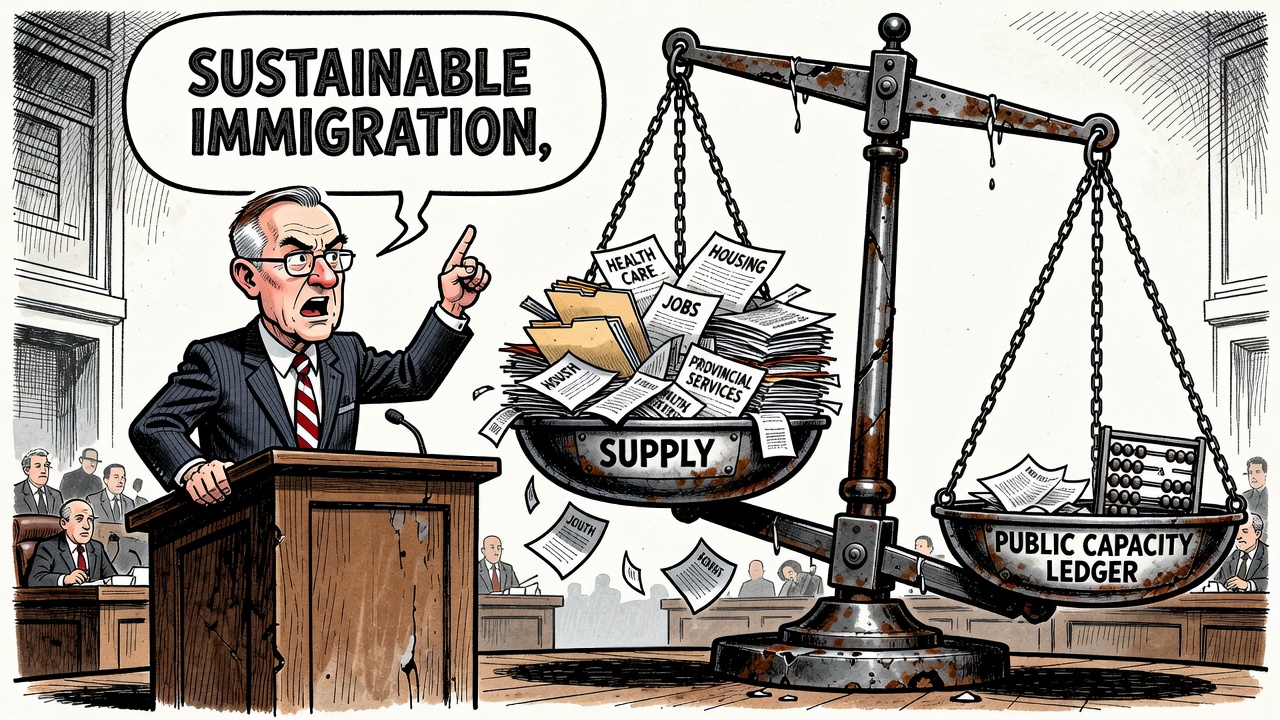
Prime Minister Mark Carney says Ottawa has “retaken control” of immigration and “will not budge” from overall levels he calls sustainable. That may be reassuring language in a press conference. It is not yet accountability.
The Canadian Press reported October 21 that Carney would not rule out a Quebec-style immigration arrangement for Alberta after preliminary results showed about 53% of Alberta voters backing more provincial control over immigration to reduce newcomers to sustainable levels. The same report said Ottawa’s current plan targets 385,000 permanent resident admissions in 2026, then 370,000 in both 2027 and 2028, with updated federal levels due next month.
There is nothing anti-immigrant about asking for the capacity math. Conservatives should say this clearly: immigration can strengthen Canada when it is lawful, skilled, properly screened and matched to homes, jobs, schools, health care and wages. But when Ottawa hides behind words like “sustainable,” provinces are left to pay service costs, young workers face tougher entry-level competition, renters face tighter markets, and newcomers themselves arrive into systems already under strain.
The labour-market side deserves special scrutiny. On October 16, Immigration, Refugees and Citizenship Canada announced Express Entry changes starting November 3, 2026. Candidates can receive additional points for eligible Canadian work experience or a qualifying job offer in a high-wage occupation. IRCC also said a Labour Market Impact Assessment will no longer be required for a qualifying job offer to receive the new Express Entry points or meet job-offer requirements under the Federal Skilled Worker Program and Federal Skilled Trades Program, though Ottawa says it will still assess whether offers are genuine.
That is exactly where slogans become risky. The LMIA system is imperfect and bureaucratic. But removing an independent labour-market gate while insisting the plan is sustainable requires proof, not trust. Canadians deserve to know which occupations qualify, which employers are using the pathway, what wages are actually paid, what anti-fraud checks are triggered, and whether Canadian workers were available before immigration points helped fill the job.
Alberta’s referendum pressure is a warning signal. Provinces deliver hospitals, classrooms, roads and many newcomer services. If Ottawa keeps final control over national levels, Ottawa should publish a national and province-by-province capacity ledger: housing starts versus intake, rental vacancy rates, youth unemployment, wage growth, health-care wait times, school enrolment pressure, temporary-resident exits, asylum backlogs, credential-recognition bottlenecks and settlement-service funding.
Carney may be right that Canada needs skilled newcomers. But “sustainable” cannot mean whatever the federal cabinet says this month. Publish the ledger before the next levels plan, before any Alberta side deal, and before no-LMIA job offers become another black box in the immigration system.
- Canadian Press via iNFOnews: Carney isn’t ruling out a Quebec-style immigration deal for Alberta
- Immigration, Refugees and Citizenship Canada: Canada refocusing Express Entry on top talent that drives economic growth
This article supports legal, skilled immigration matched to measurable Canadian capacity. It argues that federal claims about sustainability should be backed by public, auditable data.