The $5.3B Fuel-Tax Deadline U-Turn
A tax holiday sold as temporary has now become a multi-billion-dollar deadline extension. Canadians deserve the full fiscal ledger before Ottawa moves the goalposts again.
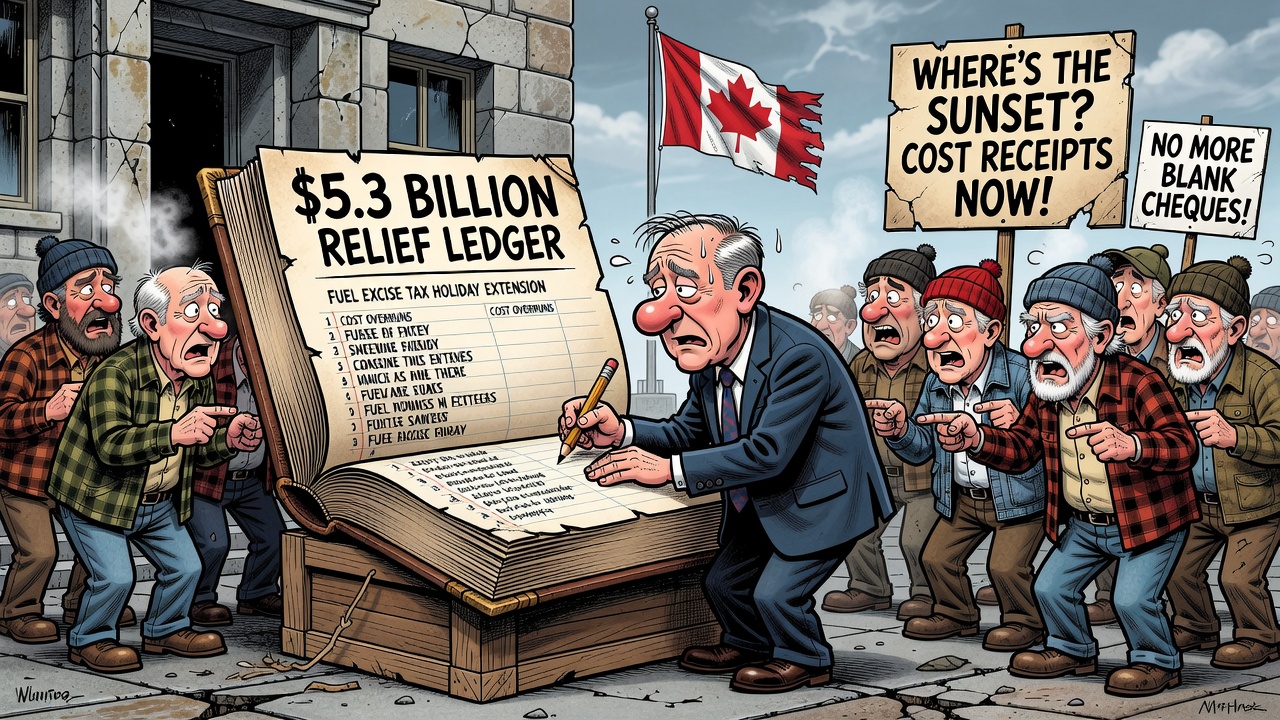
Finance Canada announced on September 2 that the federal fuel excise-tax suspension will continue until January 31, 2027. Instead of the full tax returning after the previous September deadline, Ottawa now plans a half-rate phase-in from February 1 through March 31, 2027, with the full rates returning on April 1, 2027.
For drivers, truckers, farmers, builders and delivery businesses, cheaper fuel is welcome. The problem is not that Canadians like paying less at the pump. The problem is that the Carney government waited until days before the earlier expiry to extend a “temporary” measure, while quietly turning the policy into a much larger fiscal decision.
Finance Canada’s own numbers make the accountability issue clear. The government says the original suspension began April 20, 2026 and saved 10 cents per litre on gasoline and unleaded aviation gasoline, 11 cents on leaded aviation gasoline, and 4 cents on diesel and aviation fuel. It now estimates the extension’s additional fiscal impact at about $2.9 billion, bringing total 2026-27 tax relief to $5.3 billion.
That is real money. If Ottawa is giving up $5.3 billion in revenue, Canadians should see the tradeoff. What spending is being reduced? What borrowing is being added? What assumptions were used for fuel volumes, inflation, provincial pass-through, and business savings? And if the measure is still temporary, why did the government need a last-minute extension instead of a transparent sunset plan months ago?
The draft legislation confirms the mechanics: after January 2027 and before April 2027, the rates are to be read as 5 cents per litre for unleaded gasoline and unleaded aviation gasoline, 5.5 cents for leaded aviation gasoline, and 2 cents for diesel and aviation fuel. That phase-in may soften the political hit of restarting the tax. It does not answer whether Ottawa has a durable affordability plan or only another deadline-management exercise.
Conservatives should be honest too: tax relief has value, especially when families and businesses are squeezed by tariffs, energy volatility and inflation. But responsible tax relief comes with a ledger. A government running federal finances cannot treat billions in foregone revenue as a press-release line item and then call it prudence.
The standard should be simple. Publish the cabinet decision date, fiscal costing, pass-through analysis, borrowing impact, communications timeline, and a hard no-surprises restart schedule. If fuel taxes are too painful to restore in September 2026, Canadians deserve to know why April 2027 will be different.
Affordability policy should not be run by cliff edge. Relief today must come with receipts tomorrow.
- Department of Finance Canada: Government extends federal fuel excise tax relief — September 2, 2026
- Department of Finance Canada: Legislative Proposals Relating to the Excise Tax Act
- Oakville News / Canadian Press: Ottawa extending gas tax holiday to January
This article supports fuel-tax relief for squeezed Canadians while criticizing the government’s fiscal transparency, deadline management and lack of a public cost-and-sunset ledger.