Release the Rejected U.S. Trade Text Before Counter-Tariffs Hit Canadians
Canadians are being asked to pay for a trade-war decision without seeing the rejected offer or the cost-benefit receipts behind it.
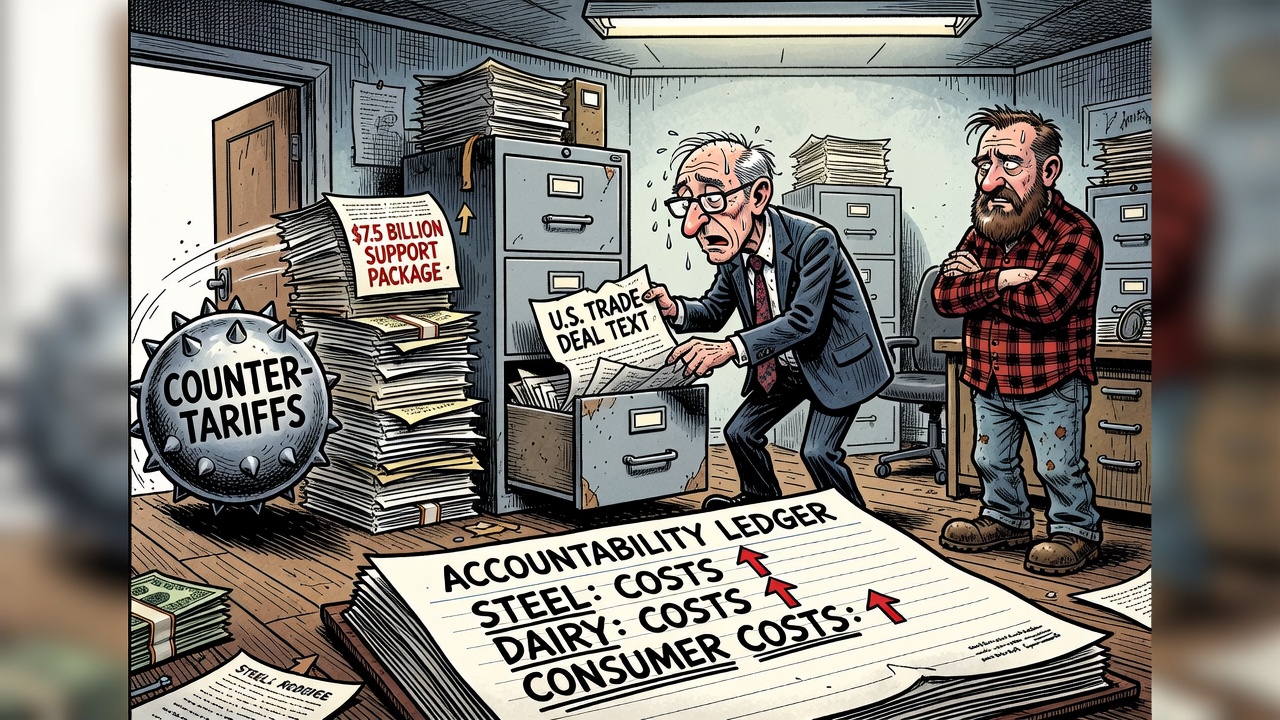
Ottawa says it walked away from a bad U.S. trade deal. Fine. Then show Canadians the deal.
Prime Minister Mark Carney told Canadians on August 22 that Canada would not accept what Washington had offered and would answer new U.S. tariffs with dollar-for-dollar countermeasures in affected sectors, including steel and dairy. Finance Canada followed on August 25 with a formal announcement: negotiations had been suspended, counter-tariffs of 15, 25 and 50 percent on $27.6 billion in U.S. imports would begin at 12:01 a.m. on September 8, and Ottawa would pair them with $7.5 billion in support for workers and businesses.
That is not a minor cabinet communications problem. It is a national cost decision. Consumers may pay more. Exporters may lose orders. Taxpayers are being asked to finance another multibillion-dollar rescue package. Yet the public still has not seen the rejected U.S. text, the concession ledger, the Canadian offer, the U.S. asks, or the sector-by-sector modelling used to justify walking away.
Pierre Poilievre’s demand that Carney release the proposed text is the correct accountability test. The argument is straightforward: if the U.S. side already knows what was on the table, secrecy cannot be justified as protecting Canada from Washington. The remaining question is whether Ottawa is protecting its negotiating strategy or protecting ministers from scrutiny.
A responsible government can withhold genuinely sensitive tactical details. But it cannot hide the whole bill while asking families, farms, manufacturers and small businesses to absorb the consequences. Canadians deserve to know whether Ottawa rejected an unacceptable surrender, missed a reasonable compromise, or entered talks without a realistic landing zone.
The standard should be simple. Before the September 8 counter-tariffs take effect, publish the rejected-deal ledger: the U.S. proposal, Canada’s counteroffer, the concessions Ottawa was prepared to make, the red lines it refused to cross, the expected consumer-price impact, the jobs and regional exposure by sector, the remission criteria, and the allocation plan for the $7.5 billion support package.
This is not about cheering for Donald Trump’s tariffs. Those tariffs punish Canadian workers and distort trade. It is about refusing to let Ottawa answer one opaque tariff shock with another opaque tariff shock and then call the secrecy patriotism.
Trade wars create winners and losers. Connected firms hire lobbyists. Favoured sectors get carve-outs. Ordinary Canadians get higher prices and vague slogans about standing strong. If Carney wants credit for refusing a bad deal, he should have the confidence to let Canadians inspect the evidence.
Release the text. Release the modelling. Release the support-package criteria. The public can handle the truth. What it should not have to handle is a counter-tariff invoice with the receipts locked in a minister’s drawer.
- Global News: Canada-U.S. trade talks and tariffs — August 22, 2026
- Global News: Canada response to U.S. tariffs — August 25, 2026
- Department of Finance Canada: Targeted countermeasures and support package — August 25, 2026
- Department of Finance Canada: Complete list of U.S. products subject to counter-tariffs
- Juno News: Poilievre demand to release rejected proposal
This article criticizes federal trade transparency and tariff management. It does not endorse U.S. tariffs; it calls for public disclosure before Canadian counter-tariffs and taxpayer supports take effect.