First Nations Wildfire Evacuees Need an Emergency Housing Ledger
The Federal Housing Advocate says First Nations evacuees faced unsafe conditions, family separation and missing supports. Publish the emergency housing ledger.
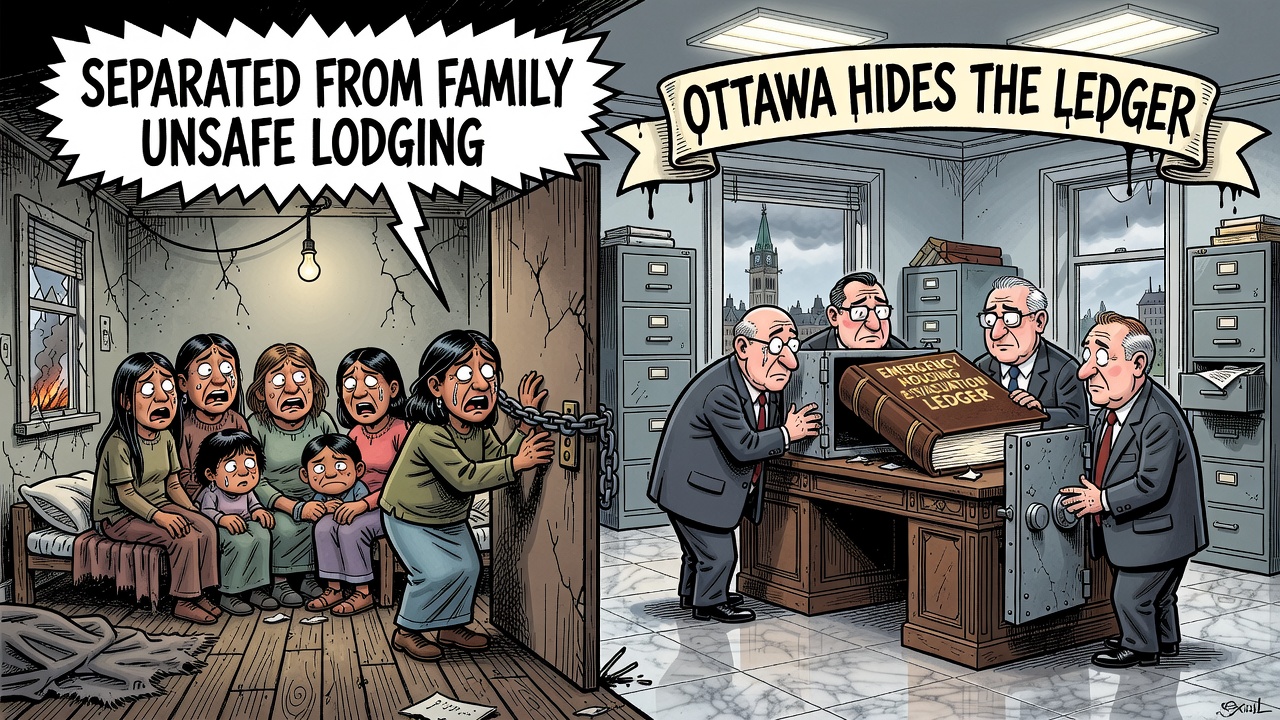
Wildfire evacuation is supposed to move people from danger to safety. A new Federal Housing Advocate report says too many First Nations evacuees were moved from one failure into another: unsafe reception conditions, family separation, weak cultural supports, unclear responsibility and long waits to return home.
The numbers are not marginal. The Office of the Federal Housing Advocate and the Assembly of First Nations say the 2025 wildfire season affected 134 First Nations, forced at least 88 communities to evacuate and displaced more than 40,000 First Nations citizens. The full report says more than 200,000 First Nations people have been evacuated because of various hazards since 2015, and that some people can end up in hotels for years during long-term evacuations.
This is where conservative accountability should be blunt. Ottawa cannot keep announcing compassion while running emergency systems that operate on improvisation, scattered contracts and after-the-fact excuses. If federal departments, provinces, municipalities, hotel contractors and relief agencies are sharing responsibility, then Canadians and First Nations communities need a public chain of command before the next siren sounds.
The report describes host communities that were not ready for medical and cultural needs, evacuees placed without regard for kinship, disability or safety, and temporary reception centres that grouped people together regardless of age, health or family situation. It says families were routinely separated. It says some hotels provided different and more limited services to evacuees, failed to provide areas for cultural practices, and in some cases left Elders with mobility aids on upper floors.
None of that is solved by another glossy climate slogan. It is solved by standards, procurement discipline and ministerial accountability. Every evacuation should have a family-unity protocol, a vulnerable-person placement standard, a cultural-support requirement, a complaint channel, a hotel inspection checklist, a safety plan for women and children, and a return-home clock tied to damage assessments, repairs and funding decisions.
The Advocate and the AFN recommend clearer emergency governance, better data sharing, full partnership with First Nations, and a First Nations Climate Emergency Housing Strategy covering evacuation lodging, urban reception, rapid return-home funding and climate-resilient reconstruction. Those are not abstract values. They are management tasks, and a serious government should be able to publish progress against each one.
Parliament should demand an emergency housing ledger: every federal transfer, every reception-centre contract, every hotel block booking, every complaint category, every family-separation incident, every cultural-support standard, every return-home delay, every reconstruction timeline and the minister responsible for fixing each gap.
First Nations communities should not have to discover the rules during the emergency. Taxpayers should not have to guess where the money went. And Ottawa should not be allowed to hide behind jurisdictional fog when vulnerable citizens are sleeping on cots, split from relatives or stuck in temporary lodging with no clear road home.
- Canadian Human Rights Commission / Office of the Federal Housing Advocate: New report calls for improved emergency responses for First Nations
- Canadian Human Rights Commission / Office of the Federal Housing Advocate: Maintaining the Right to Housing in a Changing Climate
- Blacklock’s Reporter: September 2026 archive entry, “Say Fire Evacuees Mistreated”
This article argues for public disclosure and enforceable emergency standards. It does not claim every official, host community or contractor mistreated evacuees.