The Net-Zero Accountability Escape Hatch
Ottawa passed a law with “accountability” in the title. Now the Carney government is telling a court the minister has no duty to update the plan when the policy map changes.
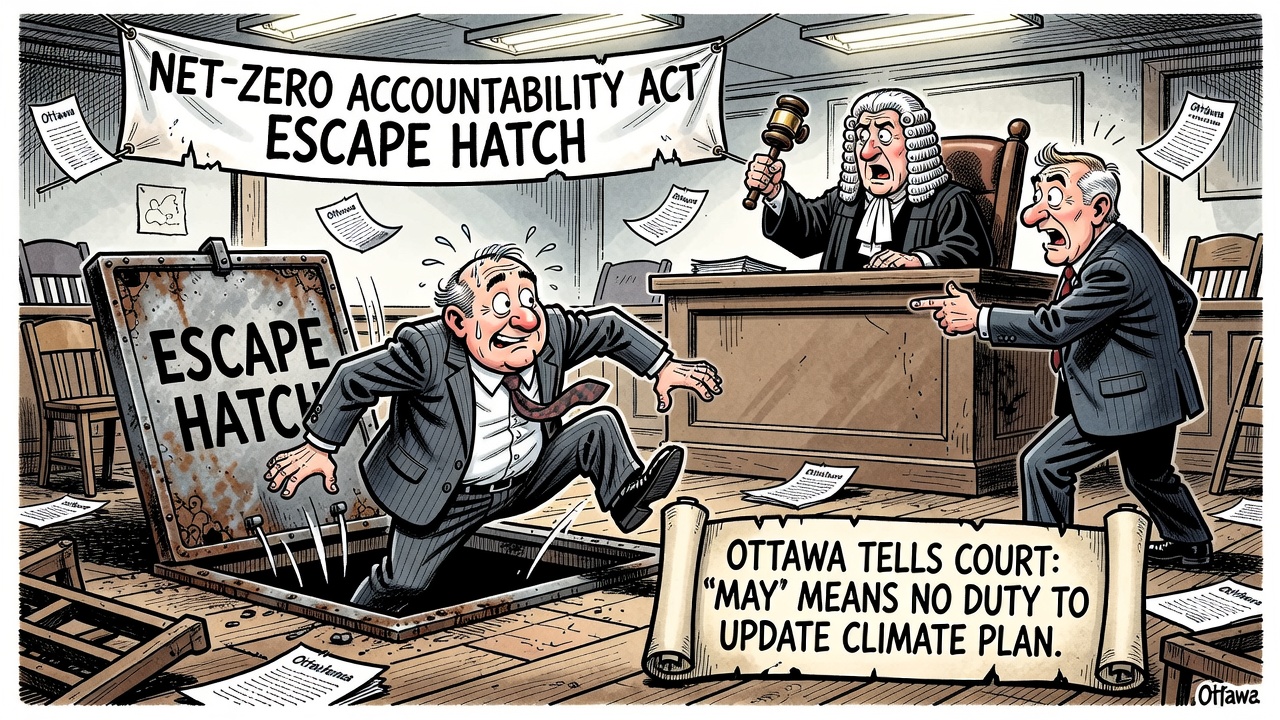
The Carney government’s latest climate-court argument deserves more attention than another round of green slogans. CBC reporting carried by Yahoo News says Ottawa has asked Federal Court to strike a lawsuit before full hearings, arguing it is not required to update Canada’s climate plan to meet national emissions-reduction targets.
The lawsuit was launched in June by three young people and two environmental groups. They want the court to order Ottawa to amend its climate plan. Their core allegation is straightforward: the Canadian Net-Zero Emissions Accountability Act is supposed to mean something when government policy changes make the old plan less credible.
Ottawa’s response leans on one small but revealing word. The Act says the minister “may” amend an emissions target or emissions-reduction plan. In its court submission, the government argues that “may” does not impose an obligation to amend. It also says broad political and policy issues are beyond the court’s institutional capacity.
That may be a defensible legal argument. Courts are not elected governments, and judges should not be writing climate policy. But politically, the argument exposes the problem conservatives warned about from the start: Liberal “accountability” often means process theatre unless citizens can see hard obligations, consequences and receipts.
The federal government’s own public description says the Act provides a framework of accountability and transparency, establishes a legally binding process to set five-year emissions targets, and requires credible, science-based plans. The statute itself says its purpose is to require national targets and promote transparency, accountability and immediate action. If Ottawa’s position is that a major policy rollback does not require an updated 2030 plan, Canadians should be told that plainly.
This matters even to voters who oppose aggressive climate regulation. A government that spends, taxes, regulates and subsidizes in the name of emissions targets must show its math. If targets are binding enough to justify higher costs, industrial rules, procurement preferences and subsidy programs, then the same targets should be binding enough to trigger updated public modelling when the plan changes.
The minister’s office reportedly did not answer whether the government will update the 2030 plan, saying only that Ottawa remains committed to fighting climate change and cannot comment further because the matter is before the courts. That is not good enough. “Before the courts” may limit comments on litigation strategy; it does not prevent the government from publishing current emissions projections, removed measures, replacement measures and a timetable for Parliament.
Conservative accountability does not require pretending climate policy is simple. It requires refusing to let Ottawa use grand statutory language for press conferences and narrow statutory language in court. If the Act binds the government, publish the updated plan. If it does not, stop marketing it as accountability.
- CBC via Yahoo News: Carney government asks court to strike down climate litigation
- Justice Laws Website: Canadian Net-Zero Emissions Accountability Act
- Government of Canada: Canadian Net-Zero Emissions Accountability Act overview
This article relies on public reporting, federal law and Government of Canada materials. It criticizes the government’s accountability position and calls for disclosure; it does not allege unlawful conduct by any litigant, public servant or elected official.