Ottawa’s Defence Boom Needs a Public Procurement Winners Ledger
If Ottawa is creating a wartime-style defence-industrial boom, Canadians deserve to know who wins before the invoices arrive.
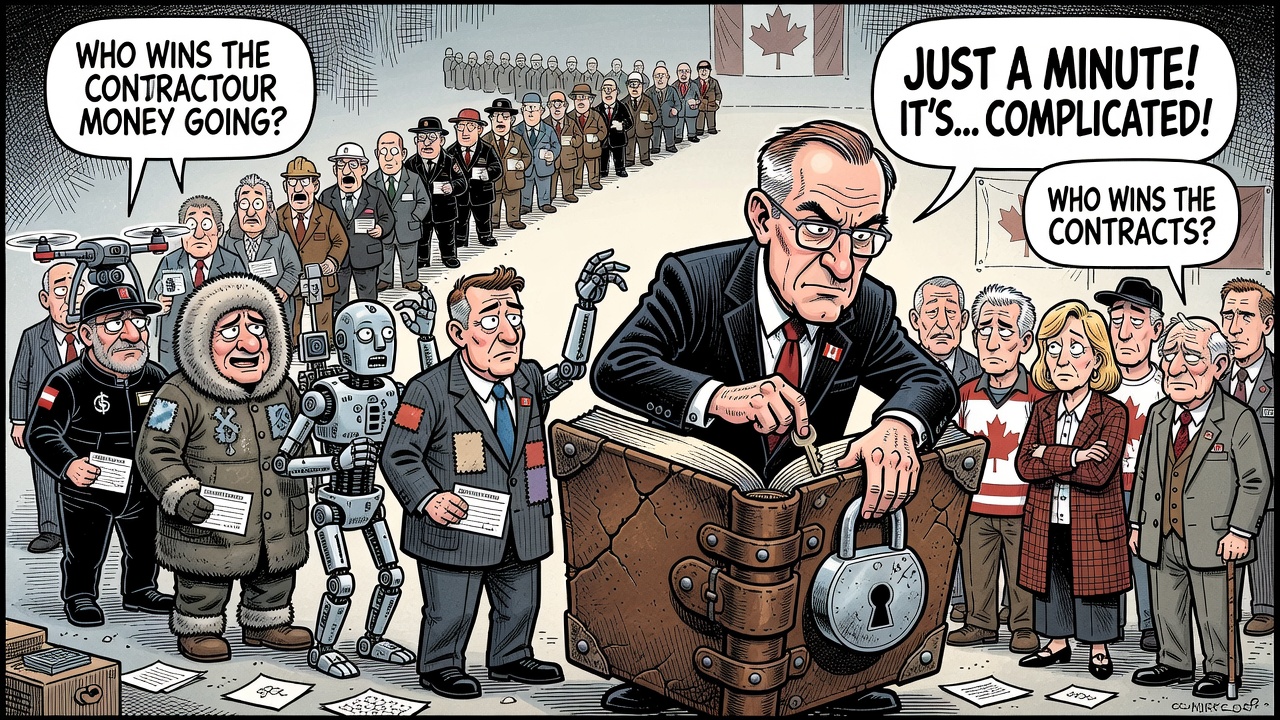
Canada is entering a defence-industrial boom. That may be necessary after years of complacency, shrinking readiness and a more hostile world. But when Ottawa deliberately steers tens of billions of dollars toward selected sectors and suppliers, taxpayers need more than patriotic language. They need a public winners ledger.
The Associated Press reports that Canada is trying to reduce dependence on American military suppliers as relations with Washington fray. Canadian firms in garments, drones, Arctic equipment, robotics and dual-use technology are already moving toward defence work. AP also reports that the Carney government’s defence plan earmarks an additional $60 billion over five years, while the broader strategy envisions more than half a trillion dollars in investment, 125,000 jobs and a tripling of Canada’s defence industry over the next decade.
The government’s own Defence Industrial Strategy confirms the scale of the ambition. Ottawa says it wants a Build–Partner–Buy framework, a new Defence Investment Agency, more Canadian firms in procurement, faster adoption of Canadian defence research and 70 per cent of defence acquisitions awarded to Canadian companies. The strategy also projects $180 billion in direct defence procurement investment, $290 billion in defence-related infrastructure and $125 billion in downstream economic activity by 2035.
That is not normal program spending. It is industrial policy with national-security branding. Done well, it could rebuild capacity, shorten supply chains and equip the Canadian Armed Forces faster. Done badly, it becomes a politically protected subsidy pipeline: familiar lobbyists, vague Canadian-content claims, sole-source urgency, regional photo ops and contracts announced before performance is proven.
The European angle makes the disclosure test even more important. Ottawa says Canada became the first non-European country to join the EU’s Security Action for Europe initiative, opening market access and procurement opportunities for Canadian defence firms. AP separately reports that Prime Minister Mark Carney is expected to address the European Parliament in September as Canada deepens ties with Europe after its break with Washington. If Canadian companies are being plugged into European security procurement, Canadians should see the obligations, eligibility rules and trade-offs.
Here is the conservative test: spend only what is necessary, buy what actually works, and publish the receipts before the invoices pile up. Every major defence-industrial award should disclose the recipient’s beneficial ownership, lobbying contacts, political donations where legally reportable, conflict-screen results, competitive or sole-source status, Canadian-content calculation, foreign subcontractors, delivery milestones, late penalties, intellectual-property terms and export-control conditions.
Ottawa should also separate military readiness from economic-development spin. A parka contract, a drone hub and an Arctic sensor program are not automatically failures because Canadian companies benefit. But they are not automatically successes because ministers can count jobs. The first question is whether the Armed Forces get reliable equipment on time at a defensible price. The second is whether taxpayers can verify who profited and why.
Canada may need a stronger domestic defence base. What it does not need is another black box where billions move under the cover of urgency. Publish the procurement winners ledger now — before the defence boom becomes the next accountability scandal.
- Associated Press: Canada is bolstering its defense industry as US relations fray. A boom is on for local contractors
- Associated Press: Carney to address European Parliament as Canada deepens ties after break with Trump
- Prime Minister of Canada: Prime Minister Carney launches Canada’s first Defence Industrial Strategy
- Department of National Defence: Canada’s Defence Industrial Strategy: Security, Sovereignty and Prosperity
- Prime Minister of Canada: Prime Minister Carney strengthens trade and security partnerships with European nations
This article argues for stronger public disclosure and value-for-money controls. It does not allege that any company, public servant or elected official acted unlawfully.