Canada’s Foreign Influence Registry Must Show the Money
The registry is finally live. The next accountability test is whether Canadians can see the dollars, exemptions and enforcement receipts behind foreign-influence work.
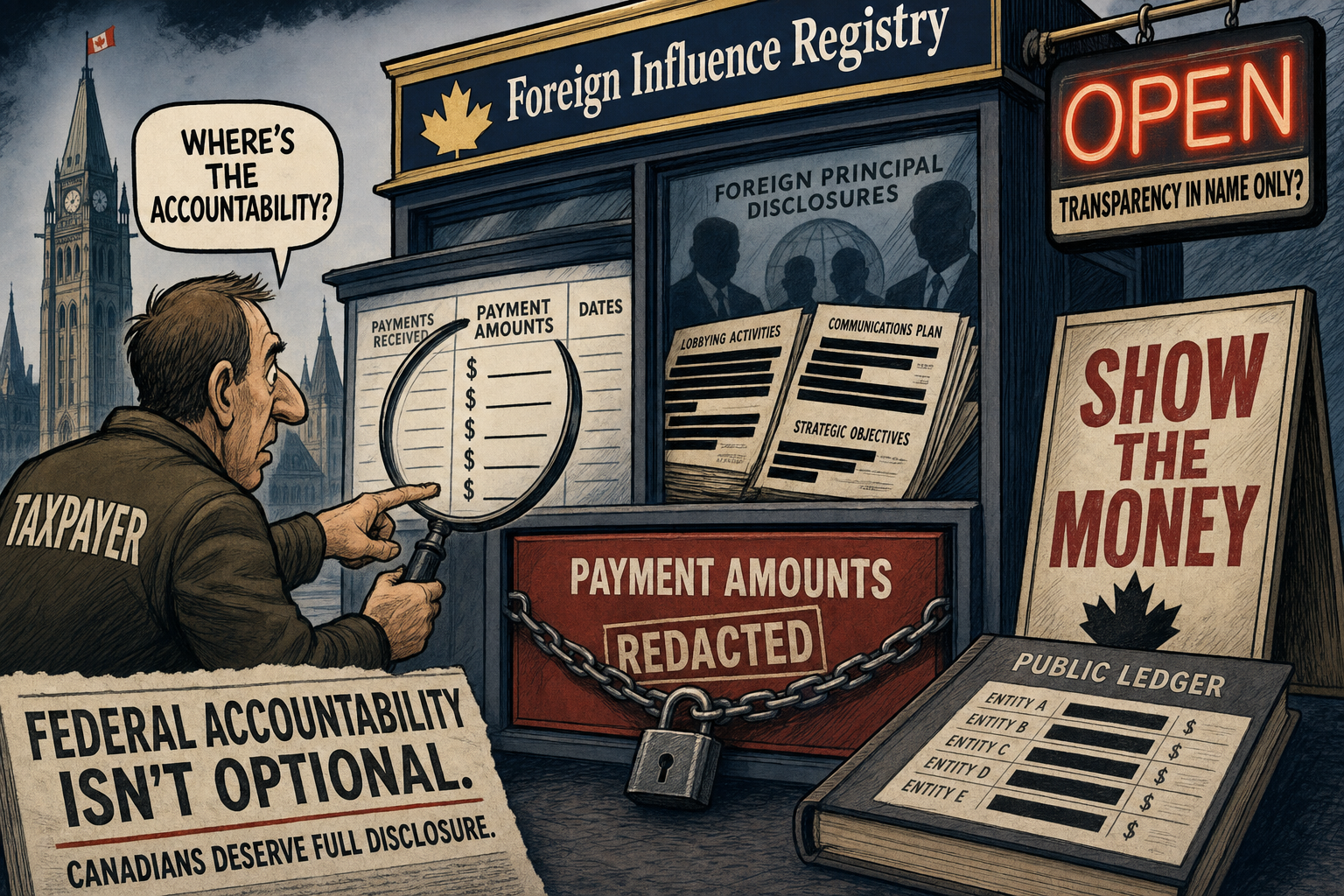
Canada’s foreign influence registry is now operating. Public Safety Canada announced on August 4 that the Foreign Influence Transparency and Accountability Act and its regulations had come into force, creating a public registry overseen by independent commissioner Anton Boegman. The government says arrangements with a foreign principal must generally be registered within 14 days, while arrangements that existed before August 4 have until October 3, 2026.
That is progress. It is not full sunlight.
The registry is supposed to show who is acting with a foreign principal to influence Canadian political or governmental processes. The commissioner’s own guidance says registration can be triggered by an arrangement aimed at influencing a legislative proposal, election, referendum or government contract, and by activities such as contacting public office holders, disseminating political information or providing money, services, facilities or items of value.
But the payment ledger is still the weak point. The final Canada Gazette regulations require registrants to provide the commissioner with information about compensation or other benefits tied to an arrangement. Yet the public-registry section excludes the amount of any compensation from what must be published. The Epoch Times, citing the regulations and Blacklock’s reporting, framed the consequence plainly: Canadians may see whether payment exists without seeing the dollar figure.
That matters because influence is not measured only by names and dates. A small honorarium, a monthly consulting contract and a seven-figure outreach campaign are not equivalent. If the public cannot see the scale, it cannot judge the seriousness of the activity, the incentives of the actor or the adequacy of enforcement. A registry that hides the money gives Canadians a label without the receipt.
There is also an exemption issue. Public Safety says registration obligations do not apply to arrangements entered by governments and parliamentary entities acting within their official mandates. Some exemptions are reasonable; diplomats and governments must do official work. But exemptions need public guardrails. Ottawa should publish plain-language examples, aggregate exemption counts and a rationale log that protects lawful diplomacy while preventing “official mandate” from becoming a convenient blackout curtain.
Global News reported the registry is increasingly important as Carney seeks improved ties with China and India, countries Canada’s security community has identified among the most active foreign-interference actors. That is exactly why this system cannot become another Ottawa checkbox. Diplomacy may be necessary. Blind trust is not.
The conservative accountability demand is simple: publish the payment ranges or exact amounts wherever legally possible, detailed benefit categories, weekly registration totals, validation backlogs, exemption statistics, average review times, investigations, penalties and correction notices. Keep personal-safety redactions where justified. Do not hide the public money trail by default.
The registry is live. Now show the money.
- Public Safety Canada: Government of Canada establishes foreign influence registry
- Office of the Foreign Influence Commissioner: Registration and compliance requirements
- Office of the Foreign Influence Commissioner: Registry of foreign influence activities
- Canada Gazette: Foreign Influence Transparency and Accountability Regulations
- Global News: Canada’s foreign influence registry is now active. Here’s how it works
- Epoch Times: Foreign agent payments won’t be revealed under Ottawa’s new regulations
This article argues for stronger public disclosure. It does not allege that any person, registrant, official or foreign principal has violated the Act or acted unlawfully.