Ethics Disclosure Compliance Needs a Public Late-File Ledger
When conflict-of-interest filings slip past deadlines, Canadians deserve a public ledger showing who was late, why, and what enforcement followed.
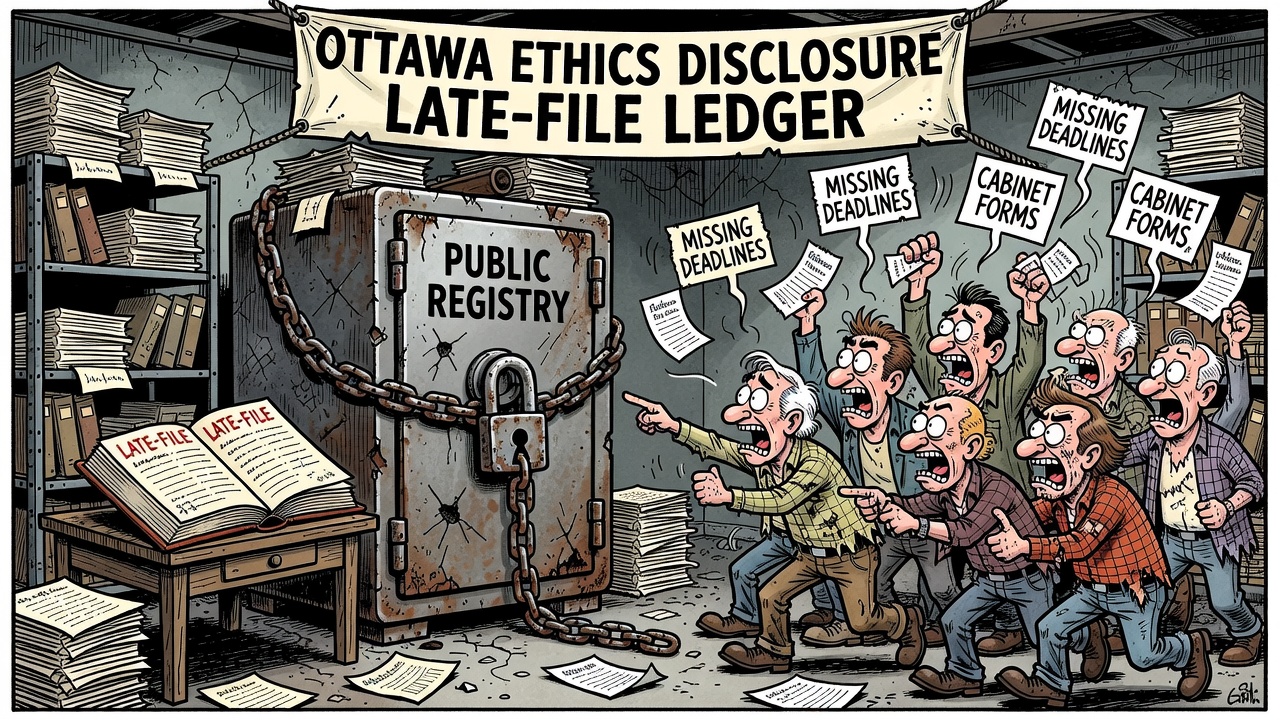
Conflict-of-interest disclosure is not paperwork trivia. It is the public’s first line of defence against ministers and MPs making decisions while Canadians are kept in the dark about private interests that may need screens, recusals or divestment.
That is why the April reporting on Indigenous Services Minister Mandy Gull-Masty mattered. Global News reported on April 22, 2026, that every Carney cabinet minister had mandatory conflict-of-interest disclosures public except Gull-Masty, whose disclosure was described as still missing from the public registry seven months after the deadline. The same report said 26 MPs still lacked public conflict-of-interest documentation: 14 Liberals, nine Conservatives and three Bloc MPs.
The publishable point now is not to pretend the file never moved. The Ethics Commissioner’s public registry later showed disclosure activity for Gull-Masty, including an April 23, 2026 MP disclosure summary and July 2026 gift and travel disclosures. Good. But that does not answer the accountability question. How long did the initial compliance file remain incomplete, what caused the delay, whether any statutory deadline was missed, and whether any penalty was considered should not require detective work by reporters and citizens.
The ethics office told Global News that it is “not unusual” for the initial compliance process under the Conflict of Interest Act to take longer than 120 days, depending on file complexity and compliance measures. That may be administratively true. It is also exactly why Ottawa needs a public late-file ledger. If late files are routine enough to explain away, they are routine enough to measure.
The Commissioner’s own 2025-26 reporting shows the registry is a major transparency system, not a side project. It says 932 public declarations by reporting public office holders were added to the registry that year, including 323 initial-compliance summary statements, 143 declarable assets, 94 liabilities, 23 recusals and 23 agreed compliance measures or screens. A system processing that much conflict information should be able to publish basic timeliness metrics without exposing private details.
A conservative accountability standard is straightforward: publish the names and offices for files past 60 days and 120 days; show whether the delay belongs to the public office holder, the Commissioner’s review, or agreed compliance measures; disclose the completion date; list penalties or reasons no penalty was issued; and flag whether a minister exercised authority while a conflict screen was still unresolved.
This is not a partisan loophole. Late disclosure by a Liberal, Conservative, Bloc or any other MP weakens public trust the same way. But cabinet is different because ministers control departments, grants, appointments and regulatory decisions. The public should not have to wait months, then guess whether a missing filing mattered.
If Carney’s government wants credit for clean government, it can start with the ledger. Ethics rules only work when deadlines mean something, compliance status is visible, and penalties are more than theoretical.
- Conflict of Interest and Ethics Commissioner: 2025-2026 annual reporting and public-registry statistics
- Conflict of Interest and Ethics Commissioner: Public Registry
- Conflict of Interest and Ethics Commissioner: Mandy Gull-Masty MP disclosure summary, April 23, 2026
- Global News: Carney’s cabinet have their conflict of interest forms public, except one
This article argues for public timeliness and enforcement metrics. It does not allege that any listed public office holder made a conflicted decision or that a resolved filing remains missing today.