Carney’s Byelection Churn Needs a Majority-Stability Ledger
When a razor-thin majority is cycling through byelections at an unusual pace, voters deserve more than campaign spin. They deserve the vacancy, timing and appointment receipts.
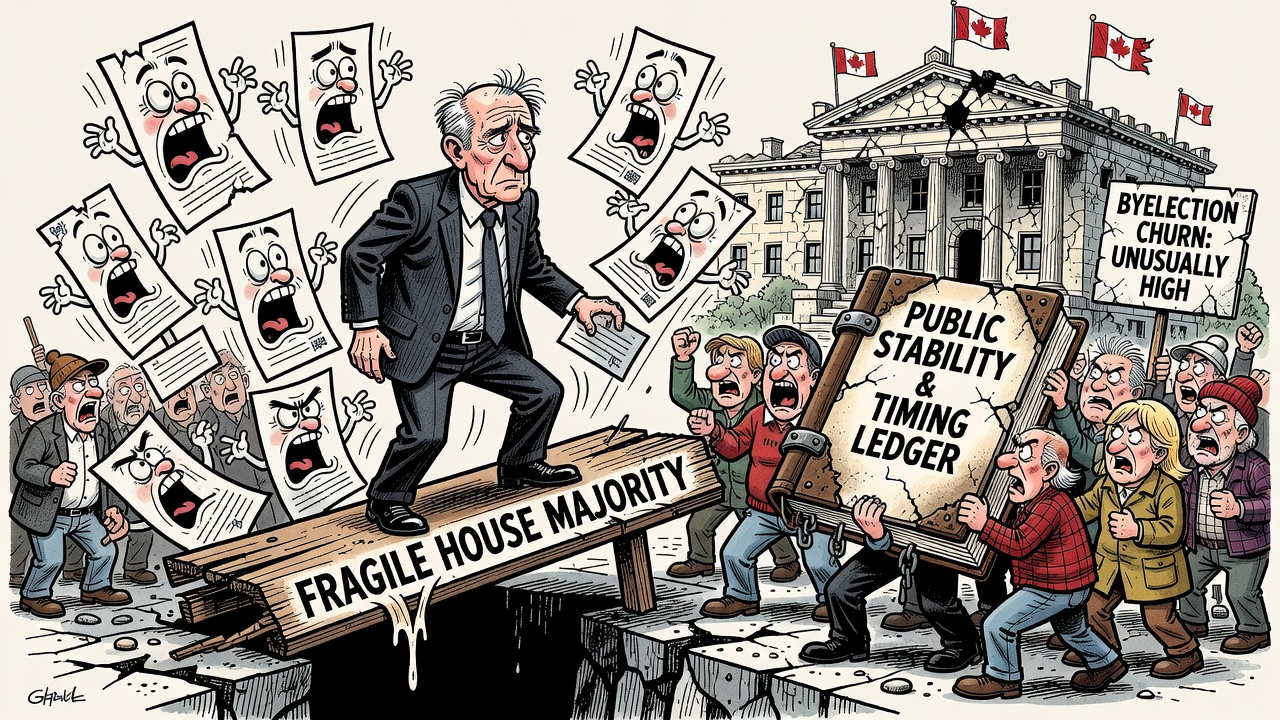
Mark Carney’s government is discovering that a majority on paper is not the same thing as stability in practice.
The Hill Times reported on August 14 that Carney has called seven byelections since his April 2025 election and is expected to call at least six more before the end of 2026. Its accessible summary also says that is the highest number of byelections called in such a short period since the 1950s, while strategists describe the churn as a mix of coincidence and a rapidly changing political environment.
That may be true. Some vacancies are routine. Members resign, retire, accept appointments or leave public life for personal reasons. But the accountability question does not disappear just because each vacancy has its own story. When the government’s majority is described as “razor-thin,” every vacancy becomes part of the governing math. Every delayed writ, every appointment-linked opening and every campaign resource decision can affect what Parliament looks like when MPs return to confidence votes, budget votes and committee fights.
Conservatives should be careful not to overstate the case. A byelection is not automatically a scandal. Elections Canada administers contests under public rules, and voters in each riding get the final say. But Liberals also should not pretend this is harmless inside-baseball. If Ottawa is producing a level of byelection turnover not seen in generations, Canadians are entitled to understand whether this is normal attrition, strategic timing, patronage fallout, caucus instability or some mix of all four.
The receipt test is simple. Publish a majority-stability ledger. For each vacancy, list the date the seat became vacant, the legal deadline to call the byelection, the date the writ was issued, the public reason for the vacancy, any appointment or government role connected to the departure, the nomination timeline for each governing-party candidate, and the cabinet or PMO decision-maker responsible for the timing recommendation.
That ledger should also disclose how many more vacancies Ottawa expects before year-end, without pretending to know private personal decisions. If six more byelections are already widely expected, the government can at least explain the known categories: announced departures, appointment-related vacancies, administrative deadlines and ridings where voters are being asked to wait.
Carney sold himself as the grown-up manager who would bring competence and order. A government constantly returning to local ballots while holding a narrow majority should be willing to show its work. Voters do not need palace gossip. They need the democratic bookkeeping.
If the churn is innocent, a transparent ledger will prove it. If the timing is strategic, Canadians should know that too. Either way, the standard for a fragile majority should be public receipts, not another round of Ottawa insiders telling voters to trust the process.
- The Hill Times: With a “razor-thin” majority, unusually high number of byelections come with great stakes
- Elections Canada: Current and past federal by-elections
- Prime Minister of Canada: Prime Minister announces by-elections
This article argues for public disclosure around byelection timing and vacancy management. It does not allege illegal conduct by Elections Canada, candidates or local riding associations.